
INTRO
Gold and silver don’t just trade on supply and demand.
They trade on control -- the kind powerful institutions use when rising precious metals threaten the stability of the financial system.
Here is a simple look at how that control works:
a daily effort in the paper markets to keep precious metals from breaking out,
and what it means when the effort becomes constant.
MEET THE HAMMER / MR. SLAMMY / GOLIATH
He doesn’t work for a bank in the usual sense.
He works for the system.
His job is to keep gold and silver quiet.
Because when gold and silver rise quickly, they expose something uncomfortable:
the financial system is more fragile than advertised.
They call him The Hammer because his tool is simple --
he hits the market with huge waves of paper selling.
Not real metal.
Not bars or coins.
Just contracts -- claims to metal that don’t exist in the vault.
That selling forces prices down.
It calms the headlines.
It buys time.
Years ago, The Hammer only showed up on big days:
Fed meetings, crises, major announcements.
Then it became monthly.
Then weekly.
Now he’s there every single day.
Sometimes multiple times a day.
Why?
Because the physical market -- the real metal -- is getting tight.
Central banks are buying aggressively.
Industrial demand is surging (batteries, solar, EVs, nuclear).
Delivery requests on the exchanges keep rising.
And the spreads and borrowing costs behind the scenes are flashing stress.
Everyone can see it now -- even retail.
And The Hammer knows it.
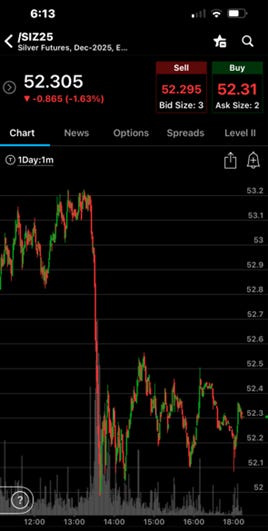
A HAMMER SWING IN REAL TIME
This is what it looks like when a wall of selling hits the tape all at once.
No news.
No headline.
Just a straight, vertical drop -- the kind that happens faster than real buyers can respond.
His problem isn’t strategy.
It’s physics.
You can flood the market with paper.
You cannot create physical metal that isn’t there.
You can delay price discovery,
but you can’t stop it.
So, he keeps hammering the market,
trying to hold the line a little longer --
hoping the pressure breaks somewhere else first.
Every slam buys a few more hours.
A little more calm.
A little more denial.
But many understand the truth:
When The Hammer finally misses --
when real demand overruns the paper -- the market stops believing the contracts and starts demanding metal.
Prices gap, liquidity thins, and the system is forced to settle in truth instead of promises.
That’s when the system he protects starts to crack.
And that’s when David (vs. Goliath) steps forward.
Not to fight.
Not to win.
But simply to hold something real in a world built on promises.
C&P AFTERWARD
Suppression is not a sign of strength.
It’s a sign of strain.
The more effort required to hold something down,
the more important it is to understand why it keeps trying to rise.
Control is loud.
Confidence is quiet.
And real is rare.